
What Is Cloud Hosting?
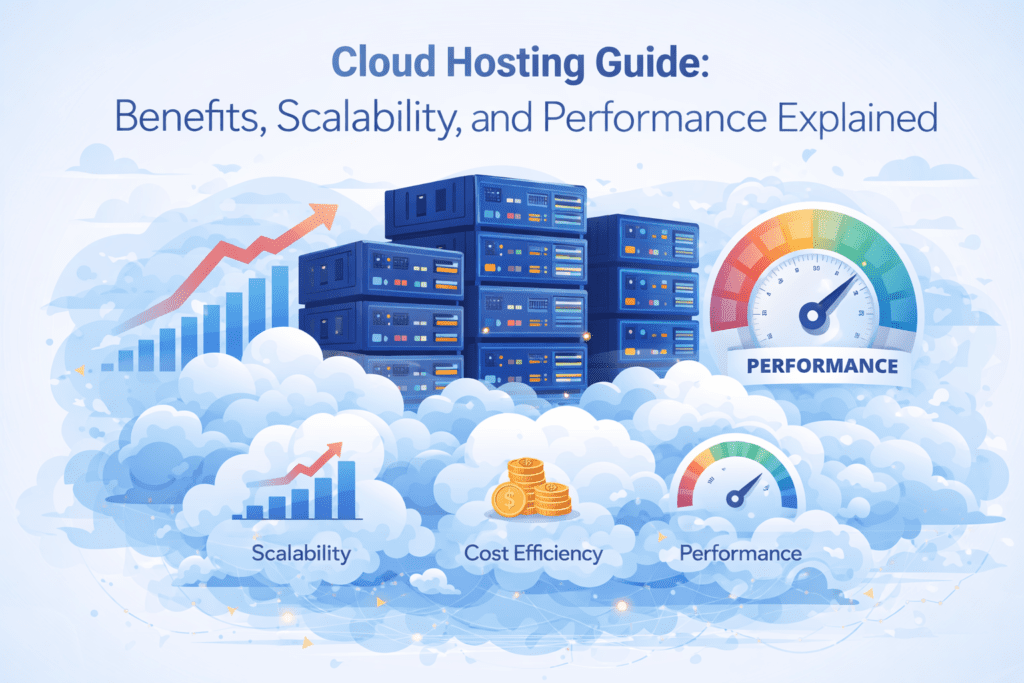
Cloud hosting is a type of web hosting that uses multiple interconnected servers to distribute resources and manage workloads. Instead of relying on a single physical server, your website runs on a network of virtual servers that work together as one
This interconnected structure is commonly referred to as “the cloud.”Because your website is not dependent on just one machine, it can access resources from multiple servers. This improves stability, performance, and reliability.
How Cloud Hosting Works
In traditional hosting, your website is hosted on a single server. If that server experiences issues, your website may slow down or go offline.
With cloud hosting, resources such as CPU power, memory, and storage are distributed across multiple servers. If one server fails or becomes overloaded, another server in the network automatically steps in to maintain performance.
Many cloud hosting environments pull resources from multiple data centers located in different geographic regions. This distributed structure improves uptime and reduces the risk of service interruptions.
Key Benefits of Cloud Hosting
1. Scalability
Cloud hosting allows you to scale resources up or down based on demand. If your website experiences traffic growth, additional resources can be allocated instantly. When traffic decreases, you can scale back.
This flexibility makes cloud hosting ideal for businesses with fluctuating traffic patterns.
2. Cost Efficiency
One of the biggest advantages of cloud hosting is its pay-as-you-go model. You typically pay only for the resources you use.
Instead of investing in expensive infrastructure upfront, businesses can manage hosting costs more efficiently and avoid paying for unused capacity.
3. Improved Reliability
Since your website operates across multiple servers, the risk of downtime is significantly reduced. If one server encounters a problem, another can compensate immediately.
This redundancy ensures higher availability compared to traditional single-server hosting.
4. Better Performance
Cloud hosting can deliver strong performance because workloads are balanced across several servers. This prevents resource bottlenecks and improves loading speeds.
Read more:
Shared vs VPS vs Cloud Hosting
Cloud Hosting vs Clustered Hosting
Cloud hosting is often described as an advanced form of clustered hosting.
Clustered hosting also uses multiple servers, but cloud hosting operates on a much larger and more flexible network. Cloud environments typically span multiple data centers and virtualized systems, making them more scalable and resilient.
Is Cloud Hosting Right for You?
Cloud hosting is especially suitable for:
Growing businesses
E-commerce websites
Applications with unpredictable traffic
Companies that require high uptime
However, smaller websites with stable and low traffic may not always need cloud-level resources.
Choosing the right hosting solution depends on your website size, growth expectations, and technical requirements.
Final Thoughts
Cloud hosting has transformed how websites and applications are delivered online. Its distributed infrastructure, scalability, and cost flexibility make it a powerful option for modern businesses.
Understanding how cloud hosting works helps you make smarter decisions about your website’s long-term stability and growth.