
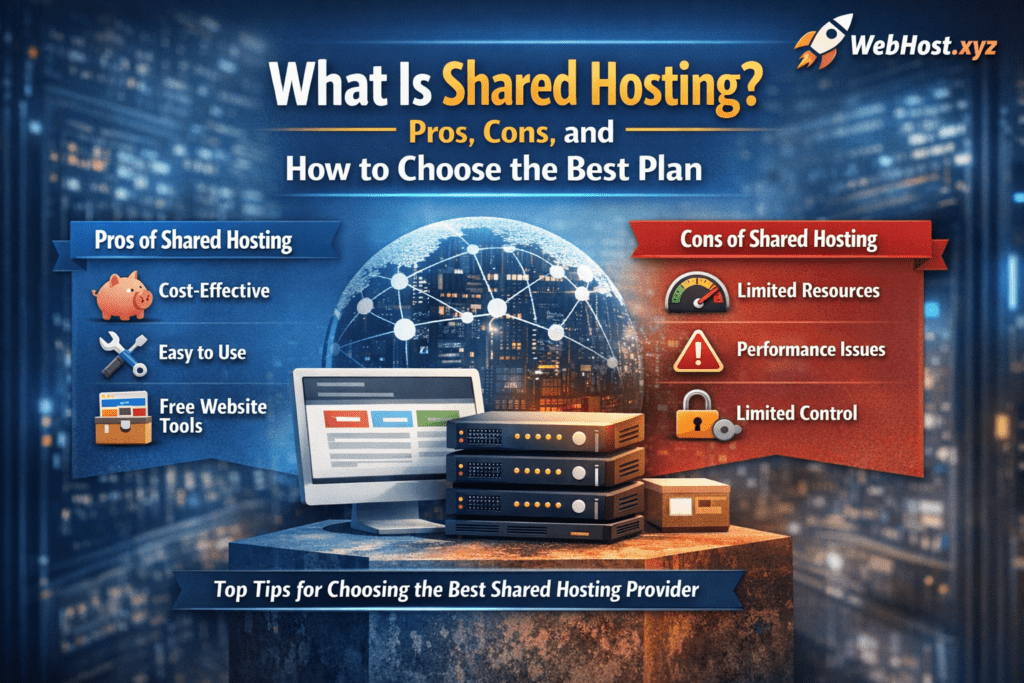
If you are starting a website, one of the first decisions you will face is choosing the right hosting type. Many beginners ask: What Is Shared Hosting, and is it the right choice for me?
At first, shared hosting seems like the perfect solution. It is affordable, easy to use, and widely available. However, as your website grows, you may start noticing performance limitations.
In this guide, you will learn everything you need to know about shared hosting, including how it works, its advantages and disadvantages, and how to choose the best provider for your needs.
What Is Shared Hosting?
Shared hosting is a type of web hosting where multiple websites share the same server and its resources.
This means:
CPU, RAM, and bandwidth are shared
One server hosts multiple websites
Costs are divided among users
As described in your original content , this setup allows hosting providers to offer low-cost plans, making it ideal for beginners and small businesses.
How Shared Hosting Works ?
In shared hosting, a system administrator manages the server.
Website owners:
Do not have full root access
Use a control panel (like cPanel)
Manage their own websites without handling server-level tasks
This makes shared hosting:
👉 Simple
👉 Beginner-friendly
👉 Low maintenance
How Storage and Bandwidth Are Measured ?
Shared hosting resources are typically measured in:
1. Storage (Disk Space)
Measured in gigabytes (GB)
Determines how many files your site can store
2. Bandwidth
Determines how much traffic your site can handle
As mentioned in your source :
High-traffic websites consume more bandwidth
Simple blogs require fewer resources
For example:
Blog → Low bandwidth
Video website → High bandwidth
Advantages of Shared Hosting
Shared hosting offers several benefits, especially for beginners.
💰 1. Cost-Effective Solution
Shared hosting is the most affordable hosting option.
Since resources are shared:
Providers reduce costs
Users get lower prices
This makes it perfect for:
Beginners
Small businesses
Affiliate marketers
⚙️ 2. Easy to Use
You don’t need technical knowledge.
Hosting providers handle:
Server setup
Maintenance
Security updates
This allows you to focus on:
👉 Building your website
👉 Creating content
🧰 3. Built-In Tools and Features
Most shared hosting plans include:
Free website builders
Templates
One-click WordPress installation
Email hosting
These features save both time and money.
🛠️ 4. Managed Hosting Environment
As stated in your original content , the hosting provider manages the server.
This includes:
Security
Updates
Performance monitoring
Therefore, you don’t need technical expertise.
Disadvantages of Shared Hosting
Despite its benefits, shared hosting has limitations.
⚠️ 1. Limited Resources
Since multiple websites share the same server:
Resources are limited
Performance may drop during high traffic
🚫 2. Performance Issues
If other websites on the server use too many resources:
Your site may slow down
You may experience downtime
This is known as the “bad neighbor effect.”
🔒 3. Limited Control
You don’t have:
Full server access
Advanced customization options
This can be restrictive for advanced users.
📉 4. Scalability Limitations
Shared hosting is not ideal for:
High-traffic websites
Large eCommerce stores
As your site grows, you may need to upgrade.
Who Should Use Shared Hosting?
Shared hosting is best for:
Beginners
Personal websites
Blogs
Small business websites
Affiliate websites
However, it may not be suitable for:
Large eCommerce stores
High-traffic platforms
How to Choose the Best Shared Hosting Provider
Choosing the right provider makes a big difference.
⭐ 1. Hostinger (Best Overall Choice)
Pros:
Excellent speed
Affordable pricing
Free SSL and domain
Easy-to-use interface
Best for:
👉 Beginners
👉 Small businesses
👉 Affiliate sites
🥈 2. Namecheap (Best Budget Option)
Pros:
Low cost
Free domain privacy
Simple dashboard
Best for:
👉 Budget users
🥉 3. InterServer (Best Long-Term Value)
Pros:
Price lock guarantee
Reliable performance
Unlimited storage
Best for:
👉 Long-term projects
Quick Comparison
Hostinger
Best performance
Best overall
Namecheap
Best price
Best for beginners
InterServer
Best stability
Best long-term
Important Factors to Consider Before Choosing
As mentioned in your original content , consider the following:
✔️ User Experience
Easy control panel
Beginner-friendly tools
✔️ Customer Support
24/7 support
Fast response time
✔️ Resource Allocation
Fair bandwidth distribution
Stable performance
✔️ Security
Secure server environment
Regular updates
Common Mistakes to Avoid
Avoid these mistakes:
Choosing the cheapest plan only
Ignoring performance
Not checking support quality
Overloading your hosting
When Should You Upgrade from Shared Hosting?
You should upgrade when:
Your traffic increases significantly
Your website becomes slow
You experience frequent downtime
Next options:
VPS Hosting
Cloud Hosting
What Is Shared Hosting (Final Thoughts)
To summarize, What Is Shared Hosting?
It is a cost-effective and beginner-friendly hosting solution that allows multiple websites to share one server.
It is perfect for starting out. However, as your website grows, upgrading becomes necessary.
Conclusion
Shared hosting is the best starting point for most websites.
It offers simplicity, affordability, and ease of use. However, understanding its limitations helps you make smarter decisions in the future.
Start with shared hosting, grow your website, and upgrade when needed.