
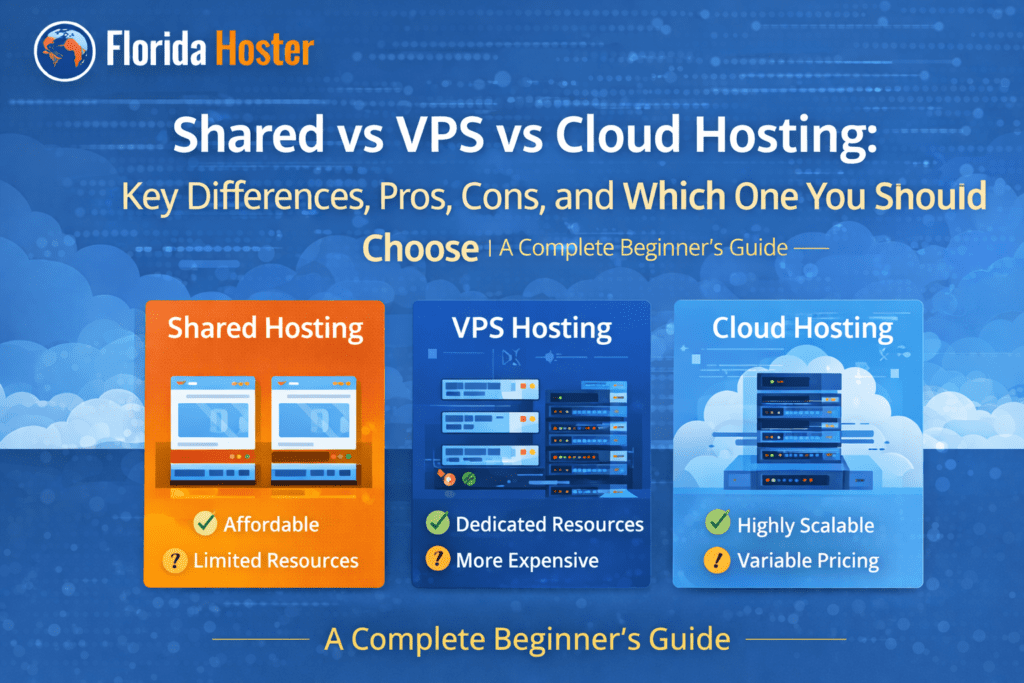
Choosing the right web hosting plan is one of the most important decisions for any website owner. Whether you’re starting a blog, launching an eCommerce store, or building a business website, understanding the difference between Shared Hosting vs VPS Hosting vs Cloud Hosting can save you time, money, and serious performance issues.
In this complete beginner’s guide, we’ll break down:
- What shared hosting is
- What VPS hosting is
- What cloud hosting is
- The key differences between them
- Pros and cons of each hosting type
- Which hosting solution is best for your needs
What Is Shared Hosting?
Shared hosting is the most basic and affordable type of web hosting.
With shared hosting, your website shares server resources (CPU, RAM, storage, bandwidth) with multiple other websites on the same server.
Think of it like renting an apartment in a large building — you share the infrastructure with others.
✅ Pros of Shared Hosting
- Low cost (best for beginners)
- Easy setup (no technical knowledge required)
- Managed by hosting provider
- Great for small websites and blogs
❌ Cons of Shared Hosting
- Limited performance
- Slower speed during high traffic
- Resource restrictions
- Less control over server configuration
Best For:
- Beginners
- Personal blogs
- Small business websites
What Is VPS Hosting?
VPS stands for Virtual Private Server.
With VPS hosting, you still share a physical server with others, but your website gets its own dedicated portion of server resources using virtualization technology.
It’s like living in a townhouse instead of an apartment — you still share the building structure, but you have more privacy and guaranteed space.
✅ Pros of VPS Hosting
- Dedicated CPU and RAM
- Better performance than shared hosting
- More control and customization
- Scalable resources
- Improved security
❌ Cons of VPS Hosting
- Higher cost than shared hosting
- Requires some technical knowledge
- Server management may be needed
Best For:
- Growing websites
- Medium traffic sites
- eCommerce stores
- Developers
- Businesses expecting traffic growth
What Is Cloud Hosting?
Cloud hosting uses multiple interconnected servers instead of relying on a single physical machine.
Your website runs on a network of servers (the cloud). If one server fails, another automatically takes over.
Think of it like having access to unlimited power from multiple sources instead of depending on one machine.
✅ Pros of Cloud Hosting
- High scalability
- Excellent uptime
- Handles traffic spikes easily
- Flexible pricing (pay for what you use)
- High reliability
❌ Cons of Cloud Hosting
- Pricing can be unpredictable
- Slightly more complex setup
- Can be expensive for high usage
Best For:
- High-traffic websites
- SaaS platforms
- Large online stores
- Fast-growing startups
- Websites with unpredictable traffic
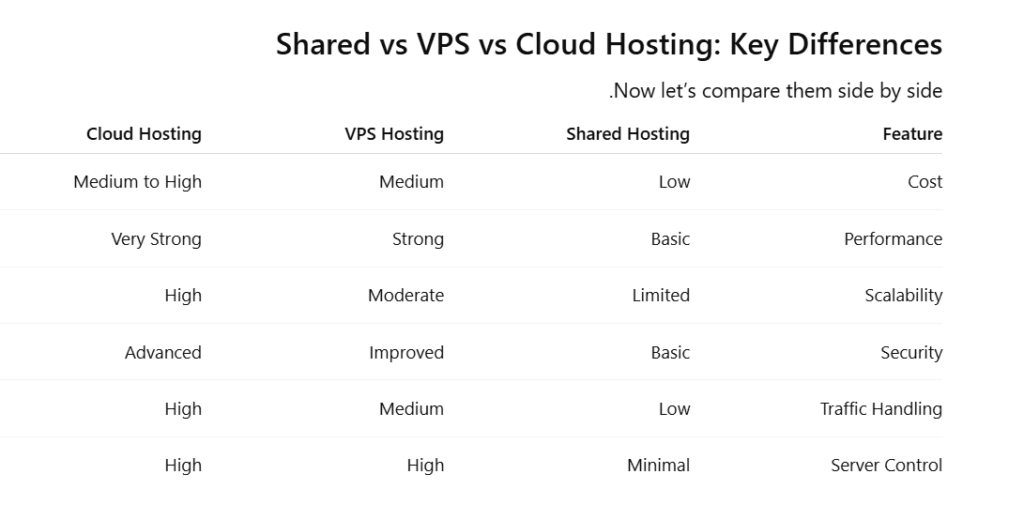
Performance Comparison
If website speed and uptime matter to you (which they should), here’s what you need to know:
Shared Hosting Performance
- Limited CPU and RAM
- Slows down during traffic spikes
- Not ideal for heavy websites
VPS Hosting Performance
- Stable resources
- Handles moderate traffic growth
- Faster load times
Cloud Hosting Performance
- Best for traffic spikes
- Distributed server load
- High availability
- Excellent uptime
For SEO purposes, website speed affects Google rankings, so hosting choice impacts search visibility.
Scalability : Which Hosting Grows With You?
Scalability is critical if you expect traffic growth.
- Shared hosting → Difficult to scale
- VPS hosting → Upgrade resources manually
- Cloud hosting → Automatically scalable
If your website experiences seasonal traffic (Black Friday, viral posts, paid ads campaigns), cloud hosting offers better flexibility.
Security Differences
Security is another major factor when choosing between shared, VPS, and cloud hosting.
Shared Hosting Security
- Shared environment increases risk
- Basic security measures
VPS Hosting Security
- Isolated virtual environment
- Better protection
- Custom firewall options
Cloud Hosting Security
- Distributed infrastructure
- Advanced redundancy
- High-level enterprise security options
If you handle sensitive customer data, VPS or Cloud hosting is safer.
Cost Breakdown
Budget plays a major role in hosting decisions.
- Shared Hosting Cost
- Typically the cheapest option. Great starting point.
VPS Hosting Cost
- More expensive but offers better performance-to-price ratio.
Cloud Hosting Cost
- Flexible pricing model (pay-as-you-go). Cost depends on usage.
For small websites, shared hosting is cost-effective.
For business websites, VPS or Cloud is worth the investment.
Which Hosting Should You Choose?
Let’s simplify the decision:
Choose Shared Hosting If:
- You’re a beginner
- Your website gets under 10,000 monthly visitors
- You have a small budget
- You want easy management
Choose VPS Hosting If:
- Your traffic is growing
- You need better performance
- You run an online store
- You need more server control
Choose Cloud Hosting If:
- You expect rapid growth
- You experience traffic spikes
- You run a SaaS or scalable application
- You need high uptime and reliability
Common Beginner Mistakes
Many beginners make these mistakes:
- Choosing shared hosting for a growing business
- Upgrading too late after performance issues
- Ignoring scalability
- Focusing only on price instead of performance
- Not planning for traffic growth
Choosing the right hosting from the beginning can prevent future migration headaches.
- SEO Impact of Hosting Choice
- Hosting affects:
- Page speed
- Server response time
- Website uptime
- Core Web Vitals
- User experience
- Bounce rate
All of these factors influence Google rankings.
If you want better SEO performance, upgrading from shared hosting to VPS or cloud hosting can significantly improve site speed and stability.
Final Verdict: Shared vs VPS vs Cloud Hosting
There’s no “best” hosting type — only the best hosting for your situation.
- For beginners → Shared Hosting
- For growing websites → VPS Hosting
- For scalable businesses → Cloud Hosting
- Start small, plan smart, and upgrade strategically.
FAQs
Is VPS better than shared hosting?
Yes, VPS hosting offers better performance, security, and scalability compared to shared hosting.
Is cloud hosting better than VPS?
Cloud hosting offers better scalability and uptime, but VPS can be more predictable in cost.
Can I upgrade from shared to VPS later?
Yes. Most hosting providers allow easy upgrades.